


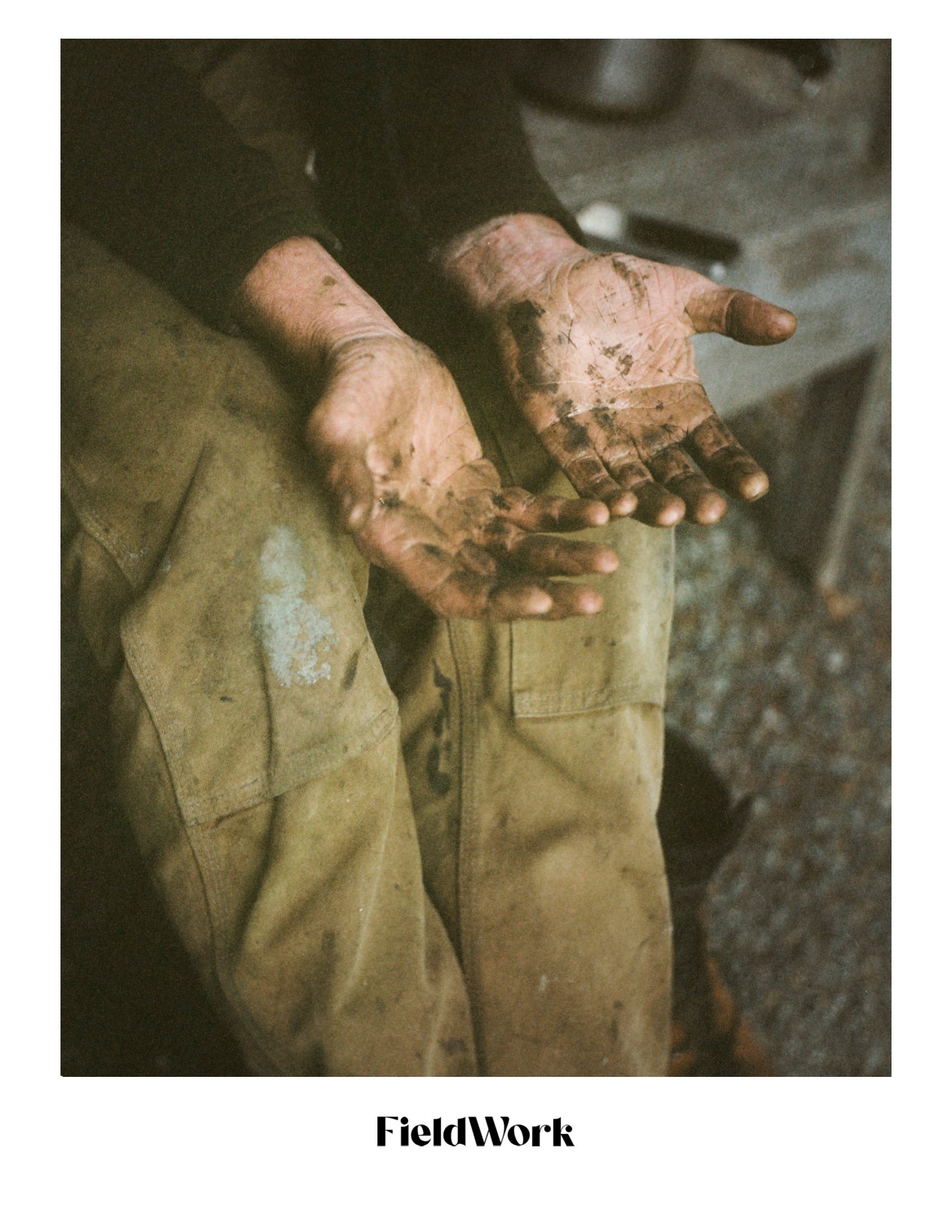
We called this issue Hands Touching Earth before we knew it would land on Earth Day. The title wasn’t chosen for the occasion. It came from a photograph — a specific pair of hands, open, resting on work trousers, caked with sap and soil. We didn’t know whose hands they were yet. We knew what the issue was about.
These three images were made during the reporting. A tunnel greenhouse in early spring, the crops barely visible through condensation and wire — a world of growing that most people drive past without seeing. A stone wall in a Connecticut field, built by hand during and after the Revolution by people whose names nobody thought to write down, still standing, still being rearranged by frost every spring. A studio shelf in NY — thirty years of accumulated material, wax pieces that function as both tool and journal, nothing discarded, everything in conversation with everything else.
None of these are extraordinary places. That is the point.
The farmer, the wall-builder, the artist — they are not doing something remarkable in the way the word usually gets used. They are doing something consistent. Something patient. Something that requires showing up on a Tuesday when nobody is watching, because the field needs clearing or the palette needs heat or the frost has moved the stones again and the wall needs tending.
FieldWork exists because we find this kind of story genuinely useful. Not inspiring in the motivational sense — useful in the way a good meal is useful, or a long walk, or a conversation that doesn’t resolve into a conclusion. It steadies something. It reminds you that most of what matters gets made slowly, by hand, in ordinary time.


We believe this belongs to everyone. There is no particular background required to understand what it means to make something carefully and pass it on. No credential that makes the stone wall more or less beautiful. The people in this issue are your neighbors — farmers, artists, ecologists, keepers of land. Their work is already around you, if you know where to look.
This is what we want to build here, in this space: not a following, but a community of people who find this kind of story as necessary as we do. People who want to make things, learn things, pass things on. People who believe, as we do, that paying attention to the ordinary is one of the most quietly radical acts available to us.
“Any sense of the extraordinary is grounded first of all in ordinary experience.” — Richard Quinney, For the Time Being: Ethnography of Everyday Life